
We measured which sources AI engines actually cite when someone asks for competitive intelligence software. Vendor blogs barely register.
Every B2B software company now has a content team writing explainers, hoping to get picked up by ChatGPT and Perplexity. We wanted to know whether that works. So we measured it — on ourselves.
We run a competitive intelligence platform that tracks, among other things, which sources AI engines cite when buyers ask questions in a given market. We pointed it at our own category and let it run.
Here is what came back, and why it changed what we publish.
The method
Ten buying-intent queries, the kind a real prospect types. Examples:
- "What companies offer AI-powered competitive intelligence platforms for small businesses?"
- "What tools combine website monitoring, competitor tracking, and AI search visibility in one dashboard?"
- "How can I keep track of my businesses competitors?"
Each query was run against ChatGPT, Perplexity, Google Gemini, and Claude, and we recorded every source cited in the answers. That produced 224 citations across 152 distinct domains in a single pass.
Two honest caveats. Gemini returns citations through an internal redirect rather than the destination URL, so we excluded those from the source analysis. Claude completed a partial set. The breakdown below therefore reflects ChatGPT and Perplexity, which between them produced the 224 parseable citations.
What gets cited
Sorting every citation by what kind of page it was:
| Source type | Share |
|---|---|
| Roundups and "best tools" lists | 45% |
| Vendor sites | 24% |
| Other (documentation, news, misc) | 24% |
| Community (Reddit, LinkedIn, forums) | 5% |
| Directories and review platforms | 3% |
The headline is that first row. Nearly half of everything the engines quoted was a list of tools.
But the vendor number is the interesting one, because it does not mean what it looks like. Of 52 vendor citations, only 8 were homepages. The other 44 were deep pages — and when we read them, nearly all were the vendor's own roundup:
- `improvado.io/blog/32-best-competitive-intelligence-companies`
- `contify.com/resources/blog/best-competitive-intelligence-tools/`
- `alpha-sense.com/blog/product/competitive-intelligence-tools/`
- `klue.com/topics/competitive-intelligence-tools-b2b-software`
- `unkover.com/blog/competitive-intelligence-tools/`
So the 45% understates it. When you count vendor-published roundups as roundups, comparison pages account for the clear majority of everything cited.
What did not get cited, in any meaningful volume: vendor thought leadership. The "how to build a competitive intelligence program" and "what is competitive intelligence" posts that every company in this category publishes. They exist by the hundred. The engines almost never quoted one.
Why this happens
It makes sense once you look at the question being asked.
"What are the best competitive intelligence tools?" is a request for a comparison across options. A model answering it needs a source that evaluates several products against each other. A vendor's explainer about competitive intelligence as a discipline does not contain that. A roundup does — it is pre-structured as exactly the comparison the question demands.
The engine is not rewarding authority. It is rewarding shape. The page that already looks like the answer is the page that gets used.
This has an uncomfortable implication for content strategy. The most common B2B content play — publish educational material, build topical authority, wait to be recognised as an expert — is optimised for a retrieval model that AI answers do not use for buying questions.
What we found when we looked at ourselves
We have 26 published posts. Every one is an explainer. Not one is a category roundup.
Our citation score across those ten queries was zero. Not zero for some engines. Zero named, zero cited, across every engine, on three consecutive scans.
Meanwhile, nine competitors we do not out-write appear repeatedly, because each of them maintains one comparison page.
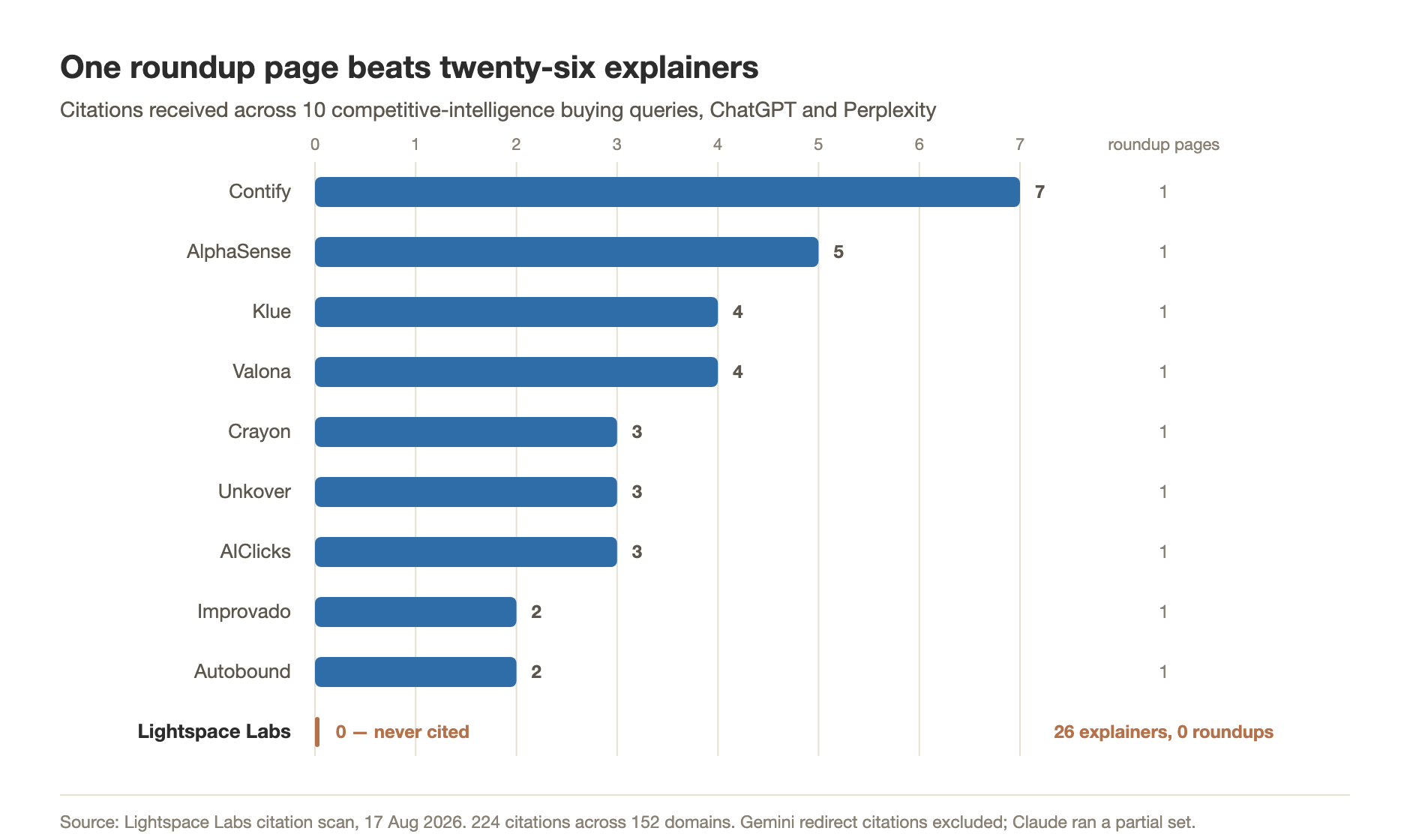
That is not a content quality problem. We would put our explainers against anyone's. It is a format problem, and no amount of additional explainer content fixes it.
What we would tell anyone in a similar position
Three things follow from this data, and they apply to any B2B category, not just ours.
Audit your content by shape, not by volume. Count how many of your pages are comparisons versus explainers. If the answer is zero comparisons, you are invisible to the highest-intent AI queries in your market, regardless of how much you publish.
Being included in someone else's roundup is worth more than your next explainer. Those pages are already cited. Getting onto one inherits the citation. It is outreach work, not writing work, and most teams never do it because it does not feel like content marketing.
Measure it rather than assume it. We believed our content was working until we counted. Every claim above came from a scan that takes minutes to run. Almost nobody in B2B is measuring which sources AI engines cite in their category, which means the gap is currently cheap to close.
We will re-run the same ten queries in thirty days and publish what moved. If the theory is right, one comparison page and a handful of placements should be visible in the next scan.
If you want the same measurement for your own category, that is what we built. There is a free snapshot at https://www.lightspacelabs.com/free-competitive-snapshot — no account, no card.
Related service
AI SEO & GEO optimization for small businesses
Automated, managed, and fully reported — on a schedule you choose.